AIMS DARE TO SUCCESS MADE IN INDIA

Friday, 5 January 2018

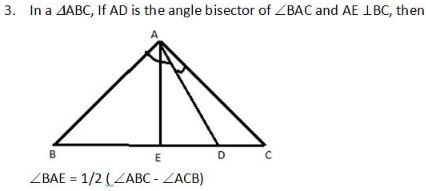
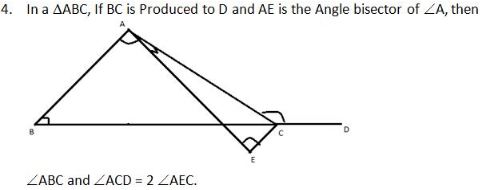
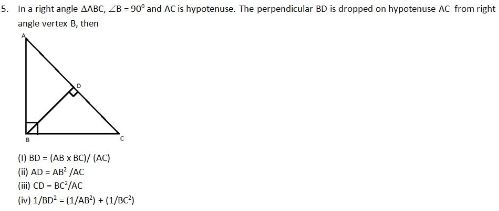
Aptitude Some Useful Shortcut Formulas in Geometry for SSC Exams

Some Useful Shortcut Formulas in Geometry for SSC Exams

Geometry topic plays an important role in SSC  EXAMS  examination and  questions are frequently asked in SSC exam which generally range from being moderate to difficult. To help in your preparation we are providing you some useful shortcuts so that you can quickly solve the questions in minimum amount of time.  In future we will provide you more important tricks and shortcuts.


Aptitude Basic Concepts & Short Tricks on Time and Work in Quant Section

Basic Concepts & Short Tricks on Time and Work in Quant Section

To make the chapter easy for you all, we are providing you all some Short Tricks to solve Time and Work Questions which will surely make the chapter easy for you all.
Basic Concepts of Work and Time:
In solving the problems based on time and work, we need to calculate the following parameters.
(A) Time : - Time taken to complete an assigned job.
(B) Individual time :- Time needed by single person to complete a job.
(C) Work:- It is the amount of work done actually.
Types of Questions and its Short Tricks
Case 1: A complete job will be considered = 1
Case 2: Assume a person ‘M’ complete a job alone in t days, then time taken by ‘M’=t
Case 3: 1 day’s work by any person
=  part of total work i.e. = 1/t
Example:- Ram can whitewash a building in 17 days. Find the work done by Ram in one day.
Solution: Here, time taken by Ram = 17 days, so 1 day’s work by Ram = 1/17th
 part of total work.
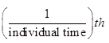
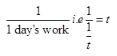
Case 4: The reciprocal of 1 day’s work gives the individual time. i.e., time taken by a single persons to complete the job =  
Example: Sunny can do 1/5th of an work in 1 day. In how many days can he complete the same work.
Solution: Time of completion by Sunny alone = individual time =
Therefore , sunny can complete the job alone in 5 days.
Case: 5: When more than one person are working on the same piece of work then their combined 1 day’s work = sum of 1 day’s work by each person. i.e., if A, B and C are three persons working on a job, then (A+B+C)’s 1 day’s work = A’s 1 day work + B’s 1 days work + C’s 1 days work.
Example: A person ‘P’ can do a work in 15 days and ‘Q’ can do it in 20 days. What amount of work is done by P and Q together in one day?
Solution: (P+Q)’s 1 day work = P’s 1 day work + Q’s 1 day work. 1 day’s work = 1/individual time
We can find (P+Q)’s 1 day work =  part of total work. So, 1 day work of P and Q = 7/60
Corollary: Work done by A in 1 day = 1 day work of (A+B+C) – (1 day work of B + 1 day work of C)
Similarly,
Work done by B in 1 day = work done by (A+B+C) in 1 day – (work done by A in 1 day + work done by C in 1 day)
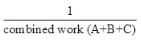
Case 6: 1. The reciprocal of combined work done in 1 day gives the tome for completion by the persons working together.
i.e., time of completion = 1/combined
= 1 day’s work.
2. It implies that if three persons, say , A, B and C are working together on a job, then Time for completion of work by them=
Example: Three persons Ram, Shyam and Kamal can do a job in 10 days, 12 days and 15 days respectively. In how many days can they finish the job working together?
Solution: Time for completion of work =
Now, as specified in case 5
Combined work in 1 day = sum of individual work done by Ram, Shaym and Kamal (Ram + Shyam+Kamal)’s 1 day work = Ram’s 1 day work + Shyam’s 1 day work +Kamal’s 1 day work
=
th part of work = 1/4th part of work
Time taken to complete the work = 1/1/4 = 4 days.
Case 7: Part of work done at any time ‘t’ by one or more persons = t × (1 day’s work)
Example: A persons ‘M’ can do a job in 25 days. How much of the job is done by him in 5 days?
Solution: Part of work done by M in 5 days = 5 × (1/25) = 1/5th part of work
Example: Two friends A and B can complete  a piece of work in 12 days and 8 days respectively. Find the amount of work done by them in 4 days.
Solution: Part of work done by (A+B) in 4 days = 4 ×(A+B)’s 1 day work
=
th part of work = 5/6th
Example:  Two persons P and Q can do a piece of work individually in 10 days and 15 days respectively. If P work for 2 days and Q works for 5 days, then find the total amount of work done.
Solution: Part of work done by P + Q = Part of work done by P in 1 day + part of work done by Q in 5 days
 the part of work = 8/15th
Case 8: If more than one person are working for different time schedules to complete a piece of work, then
(i) Assume the time for completion = T
(ii) Number of days worked by each persons in found with reference to T, if not mentioned in the problem.
(iii) Sum of the parts of work done by each person = 1, since the job is complete.
Example: Deepak and Anil can do a piece of work in 10 days and 30 days respectively. They work together and Deepak leaves 5 day’s before the work is finished. Anil finishes the remaining work alone. In how many days is the total work finished?
Solution: Assume the time for completion = T
Since Deepak leaves 5 days before the work is finished. So, no. of days worked by Deepak = T – 5 and Anil works, so, number of days worked by Anil = T
Deepak’s work + Anil’s work – 1
Total work is finished in 11.25 days.
Case 9: The ration of the work done by the two persons in the same time is the inverse ratio of their individual time.
e.g., if ‘A’ can do a work in 5 days and B can do in 9 days, then, in the same time,
( inverse of time taken when working alone)
Case 10: If a person ‘P’ is ‘n’ times as good a workman as Q, individual time for
P =
and after some time (using case 9)
Example: Tannu and Rekha can do a job in 12 days. Rekha alone can finish it in 36 days. In how many days can Tannu and alone finish the work?
Solution: (Tannu + Rekha)’s 1 days work = Tannu’s 1 day work + Rekha’s 1 day work
1/12
= Tannu’s 1 day work work + 1/36
Tannu’s 1 day work =
th of work. So, Tannu can finish it in 18 days.
Trick :
If T = 12, R = 36 then
Required time =
= 18 days


Aptitude Important Shortcuts & Formulas on Problem Based on Ages in Quant Section

Important Shortcuts & Formulas on Problem Based on Ages in Quant Section

To solve the Problem Based on Ages in Quant Section, students require the knowledge of linear equations. This method needs some basic concepts as well as some more time than it deserves. Sometimes it is easier to solve the problems by taking the given choices in account. But this hit-and-trial method proves costly sometimes, when we reach our solution much later. We have tried of questions. Although, we are not able to cover each type of questions in this section, our attempt is to minimize your defficulties.
Have a look at the following questions:-
Ex. 1: The age of the father 3 years ago was 7 times the age of his son. At present, the father’s age is five times that of his son. What are the present ages of the father and the son?
Ex. 2: At present, the age of the father is five times the age of his son. Three years hence, the father’s age would be four times that of his son. Find the present ages of the father and the son.
Ex. 3: Three years earlier, the father was 7 times as old as his son. Three years hence, the father’s age would be four times of his son. What are the present ages of the father and the son? 
Ex. 4: The sum of the ages of a mother and her daughter is 50 yrs. Also 5 yrs ago, the mother’s age was 7 times the age of the daughter. What are the present ages of the mother and the daughter?
Ex. 5: The sum of the ages of a son and father is 56 yrs. After 4 yrs, the age of the father will be three times that of the son. What is the age of the son?
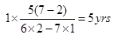
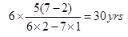
Ex.6: The ratio of the ages of the father and the son at present is 6: 1. After 5 years, the ratio will become 7 : 2. What is the present age of the son? 
By the conventional method:-
Solution: 1. Let the present age of son = x yrs
Then, the present age of father = 5xyr
3 years ago,
7(x – 3)= 5x – 3
Or, 7x – 21 =5x – 3
Or, 2x =18
x = 9 yrs
Therefore, son’s age = 9 years
Father’s age = 45 years
Solution: 2.      Let the present age of son = x yrs
Then, the present age of father = 5x yrs
3 yrs hence,
4(x+3)= 5x+3
Or, 4x + 12=5x +3
x= 9yrs.
Therefore, son’s age = 9 yrs and father’s age = 45 yrs
Solution: 3.      Let the present age of son = x yrs and the present age of father = y yrs
3 yrs earlier, 7(x – 3) = y – 3   or, 7x – y =18………….(i)
3 yes hence, 4(x+3) = y +3
Or, 4x +12 = y + 3                   or, 4x – y = - 9 …………(ii)
Solving (1) & (2) we get, x = 9 yrs & y =45 yrs
Solution: 4.      Let the age of the daughter be x yrs.
Then, the age of the mother is (50x – x)yrs
5 yrs ago, 7(x – 5) = 50 – x – 5
Or, 8x = 50 – 5 +35 = 80
x =10
Therefore, daughter’s age = 10 yrs and mother’s age = 40yrs
Solution: 5.      Let the age of the son be x yrs.
Then, the age of the father is (56 – x) yrs.
After 4 yrs, 3(x+4) = 56 – x +4
Or, 4x =56 +4 – 12 = 48
x = 12 yrs
Thus, son’s age = 12 yrs.
Solutions: 6.                           
                         Father            :           Son
Present age =        6                 :               1
After 5 yrs =           7                :               2
Son’s age =
Father’s age =
Other Method:-
Solution: 1.     
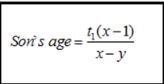
Son’s age =
=9 yrs
and father’s age = 9 × 5 = 45 yrs.
Undoubtably you get confused with the above method, but it is very easy to understand and remember. See the following form of question.
Question: t1 yrs earlier the father’s age was x times that of his son. At present the father’s age is y times that of his son. What are the present ages of the son and the father?
Formula
Solution 2: Son’s age =
= 9yrs  and father’s age = 9 × 5 =45 yrs
To make more clear, see the following form:
 Questions: The present age of the father is y times the age of his son. t2 yrs hence, the father’s age become z times the age of his son. What are the present ages of the father and his son?Formula
= 9 yrs
To make the above formula clear, see the following form of question.
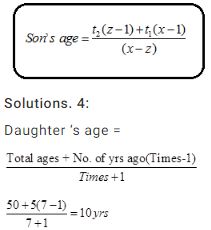
Questions: t1 yrs earlier, the age of the father was x times the age of his son. t2 yrs hence, the age of the father becomes z times the age of his son. What are the present ages of the son and the father?
Formula         
Thus, daughter’s age = 10 yrs and mother’s age = 40 yrs 
Solutions. 5:   
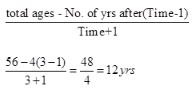
Son’s age =
Note : Do you get the similarities between the above two direct methods? They differ only in sign in the numerator. When the question deals with ‘ago’, a +ve sign exixts and when it deals with ‘after’, a –ve sign exists in the numerator.
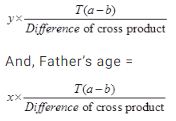
Solutions. 6:    Then what formula comes?
                                    Father                :                  Son
Present age =                  x                     :                     y
After T yrs=                     a                     :                     b
Then, Son’s age =
Note:
1. While evaluating the difference of cross-product, always take +ve sign.
2. Both the above direct formulas look similar. The only difference you can find is in the denominators. But it has been simplified as “difference of cross-products” to make it easier to remember. So, with the help of one formula only you can solve both the question.
3. We suggest you to go-through both the methods and choose the better of the two.
We hope that the post would have cleared all your doubts related to the topic.


Aptitude Simple and Easy way to learn Divisibility Rules in Quant Section

Simple and Easy way to learn Divisibility Rules in Quant Section

Traditional division method will take too much time for big numbers but if you know these divisibility rules and tricks then it will be much easier for you to solve the questions fast and with accuracy.
Simple and Easy way to learn Divisibility Rules
We now take up the interesting question as to how one can determine whether a certain given number, however large it may be, is divisible by a certain given divisor. There is no defined general rule for checking the divisibility. For different divisors, the rules differ at large. We will discuss the rule for divisors from 2 to 19.
Divisibility by 2:
Rule: Any number, the last digit of which is rather even or zero, is divisible by 2.
Ex: 12, 86 and 130 are divisible by 2 but 13, 133 and 193 are not divisible by 2.
Divisibility by 3:
Rule: if the sum of the digits of a number is divisible by 3, the number is also divisible by 3.
For example:
  1. 123: 1 + 2 + 3 = 6 is divisible by 3; hence 123 is also divisible by 3.
  2. 5673 : 5 + 6 + 7 + 3 =21; therefore divisible by 3.
Divisibility by 4:
Rule : if the last two digits of a number is divisible by 4, the number is divisible by 4 the number having two or more zeros at the end is also divisible by 4.
For example:
  1. 526428: 28 is divisible by 4. Therefore, the number is divisible by 4.
  2. 5300; there are two zeros at the end , so it is divisible by 4.
Note: The same rule is applicable to check the divisibility by 25. That is, a number is divisibility by 25 if its last two digits are either zeros or divisible by 25.
Divisibility by 5:
Rule : if a number ends in 5 or 0, the number is divisible by 5.
For example:
  1. 1345: As its last digit is 5, it is divisible by 5.
  2. 1340: as its last digit is 0, it is divisible by 5.
Divisibility by 6:
Rule: if a number is divisible by both 3 and 2, the number is also divisible by 6. So, for a number to be divisible by 6,
  1. the number should end with an even digit or 0 and
  2. the sum of its digits should be divisible by 3.
For example:
  1. 63924 : the first condition is fulfill s the last digit (4) is an even number and also (6+3+9+2+4=) 24 is divisible by 3; therefore the number is divisible by 6.
  2. 154: The first condition is fulfill but no the second; therefore , the number is not divisible by 6.
Special Cases
The rules for divisibility 7, 13 , 17, 19 … are very much unique and are found very rarely. Before going on for the rule, we should know some terms like “one- more” osculator and negative osculator.
“One- more” osculator neabs the number needs one more to be a multiple of 10.
For example:
osculator for 19 needs 1 to become 20 (=2×10), thus osculator for 19 is 2 (taken from 2 × 10 =20). Similarly osculator for 49 is 5 (taken from 5 × 10 =50)
Negative osculator means the number should be reduced by one to be a multiple of 10.
For example :
Negative osculator for 21 is 2 (taken from 2 × 10 = 20).
Similarly, negative osculator for 51 is 5 (taken from 5 × 10 = 50)
Note: (1) What is the osculator for 7?
Now, we look for that multiple of 7 × 3 =21, as 21 is one more than 2 × 10; our negative oscultor is 2 for 7.
And 7 × 7 =49 or 49 is one less than 5 × 10;  “one – more ” osculator is 5 for 7.
Similarly, oscultors for 13, 17 and 19 are ;
For 13 : 13 × 3 =39, “ one more ” osculator is 4 (from 4 × 10)
(2) Can you define osculators for 29, 39, 21, 31 ,27 and 23.
(3) Can you get any osculators for an even number or a number ending with ‘5’?
Divisibility by 7:
First of all we recall the osculator for 7. Once again, for your convenience, as 7 × 3 = 21 (one more than 2 ×10), our negative osculator is 2. This osculator of any number by 7. See how it works:
Ex 1: Is 112 divisible by 7 ?
Solution:
Step I : 11 2 : 11 – 2 × 2 = 7
As 7 is divisible by 7, the number 112 is also divisible by 7.
Divisibility by  8:
Rule : If the last three digits of a number is divisible by 8, the number is also divisible by 8. Also, if the last three digits of a number are zeros, the number is divisible by 8.
Ex 1: 1256: As 256 is divisible by 8, the number is also divisible by 8.
Ex 2: 135923120 : as 120 is divisible by 8, the number is also divisible by 8.
Divisibility by 9:
Rule : If the sum of all the digits of a number is divisible by 9, the number is also divisible by 9.
Ex 1: 39681 : 3 +9 +6+8+ =27 is divisible by 9, hence the number is also divisible by 9.
Divisibility by 10:
Rule : any number which ends with zero is divisible by 10. There is no need to discuss this rule.
Divisibility by 11:
Rule : If the sums of digits at odd even places are equal or differ by a number divisible by 11, then the number is also divisible by 11.
Ex 1: 3245682 : S1 = 3+ 4 + 6+ 2 = 15 and S2 = 2+5+8 = 15
As S1 = S2, the number is divisible by 11.
Divisibility by 12:
Rule : Any number which is divisible by both 4 and 3, is also divisible by 12.
To check the divisibility by 12, we
  1. first divide the last two-digit number by 4. If it is not divisible by 4, the number is not divisible by 12. If it is divisible by 4 then
  2. check whether the number is divisible by 3 or not.
Ex 1: 135792 : 92 is divisible by 4 and also (1+3+5+7+9+2=)27 is divisible by 3; hence the number is divisible by 12.
Divisibility by 13:
Rule : Oscuator for 13 is 4 (see note). But time, our osculator  is not negative (as in case of 7). It is ‘one-more’ osculator. So, the working principle will be different now. This can be seen in the following examples.
Ex 1: Is 143 divisible by 13?
Solution : 14 3 : 14 + 3 × 4 = 26
Divisibility by 14:
Any numberwhich is divisible by both 2 and 7, in also divisible by 14. That is, the number’s last digit should be even and at the same time the number should be divisible by 7.
Divisibility by 15:
Any number which is divisible by both 3 and 5 is also divisible by 15.
Divisibility by 16:
Any number whose last 4 digit number is divisible by 16 is also divisible by 16.
Divisibility by 17:
Negative osculator for 17 is 5 (see note). The working for this is the same as in the case of 7.
Ex1: cheek the divisible of 1904 by 17.
Solution :
190 4 : 190 – 5 × 4 = 170
Since 170 is divisible by 17, the given number is also divisible by 17.
Note : students are suggested not to go upto the last calculation. Whenever you find the number divisible by the given number on right side of your calculation stop further calculation and conclude the result.
Divisibility by 18:
Rule : Any number which is divisible by 9 and has its last digit even or zero, is divisible by 18.
Ex1: 926568 : digit -sum  is a multiple of nine (i.e. divisible by 9) and unit digit(8) is even, hence the number is divisible by 18.
Divisibility by 19:
If you recall, the ‘one- more’ osculator for 19 is 2. The method is similar to that of 13, which is well known to you. Let us take an example,
Ex1 : 149264
Solution : 1 4 9 2 6 4
19 / 9 / 12 / 11 / 14
Thus, our number is divisible by 19.
Note: you must have understood the working principle (see the case of 13).
We hope that the post would have cleared all your doubts related to the topic.


Aptitude Important Short Tricks to solve Compound Interest Questions

Important Short Tricks to solve Compound Interest Questions

To make the chapter easy for you all, we are providing you all some Important Short Tricks to solve Compound Interest Questions which will surely make the chapter easy for you all.
Important Short Tricks to solve Compound Interest Questions
Compound Interest :- Sometimes it so happens that the borrower and the lender agree to fix up a certain unit of time, say yearly or half-yearly or quarterly to settle the precious account.
In such cases, the amount after first unit of times becomes the principal for the second unit the amount after second unit becomes the principle for the third unit and so on.
After a specified period, the difference between the amount and the money borrowed is called the Compound Interest (abbreviated as C.I.) for that period.

Important Facts & Formulas on Compound Interest

Case 1: Let principle = P, time = n years and rate = r% per annum and let A be the total amount at the end of n years, then
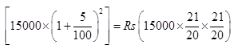
Example: Albert invested an amount of Rs.8000 in a fixed deposit scheme for 2 years at compound interest rate 5 p.c.p.a. how much amount will Albert get on maturity of the fixed deposit.
Solution: 
Amount = Rs.
Case 2: When compound interest is reckoned half-yearly.
If the annual rate is r% per annum and is to be calculated for n years, then in this case, rate = (n/2%) half-yearly and time = (2n) half-yearly.
Form the above we get
 Example: Sam investment Rs.15,000 @ 10% per annum for one year. If the interest is compounded half-yearly, then the amount received by Sam at the end of the year will be.
Solution:
P = Rs. 15000; R = 10% p.a = 5% half-year, T = 1 year = 2 half year
Amount = Rs
= Rs.16537.50
Case 3: When compound interest is reckoned quarterly.
In this case, rate = (r/4%) quarterly and time = (4n) quarter years.
As before,
Example:
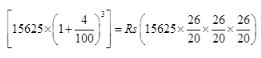
Find the compound interest on Rs. 15,625 for 9 months at 16% per annum compounded quarterly.
Solution:
P = Rs. 15625, n= 9 months = 3 quarters, R = 16% p.a. = 4% per quarter.
Amount = Rs.
= Rs.17576
C.I = Rs. (17576 – 15625 ) = Rs. 1951.
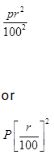
Note: The difference between the compound interest and the simple interest over two years is given by
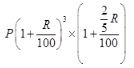
Case 4: When interest is compounded annually but time is in fraction, say  years.
Amount =
Example:
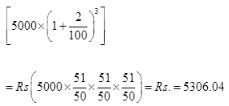
What is the difference between the compound interest on Rs. 5000 for  at 4% per annum compounded yearly and half-yearly?
Solutions:
C.I. when interest is compounded yearly
= Rs.
= Rs.5304
C.I. when interest is compounded half-yearly
Difference = Rs.(5306.04 – 5304 ) = Rs.2.04.
Case 5: Present worth of Rs.x due n years hence is given by:
Present Worth =
Example:
The principle that amounts to Rs.4913 in 3 years at  per annum compound interest compounded annually, is :
Solution:
Principle = Rs.
We hope you all like the post. Don't forget to share your feedback with us in the comment box.


Aptitude Short Tricks to find Max and Min Value of Trigonometric identity

Short Tricks to find Max and Min Value of Trigonometric identity

Type-I
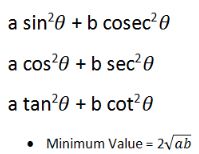
In case of sec2x, cosec2x, cot2x and tan2x, we cannot find the maximum value because they can have infinity as their maximum value. So in question containing these trigonometric identities, you will be asked to find the minimum values only. The typical question forms are listed below:
Example: -1
Find the Minimum value of 9 cos 2x + 2 sec 2x
sol - this equation is a typical example of our type-3 so apply the formula 2√ ab   so,
  • Minimum Value = 2√ 9 x  2= 2√ 18
Example:-2
Find the Minimum value of 8 tan 2x + 7 cot 2x
sol - this equation is a typical example of our type-3 so apply the formula 2√ ab   so,
  • Minimum Value = 2√ 8 x  7= 2√ 56
Type -II
Example -1
Find the Maximum and Minimum Value of 3 sin x + 4 cos y
Sol- If you find the question of this kind, apply the above formulae.
  • Maximum Value = √ 9 + 16   = √ 25   = 5
  • Minimum Value = - √ 9 + 16   = - √ 25   =  - 5
Example-2
Find the Maximum and Minimum Value of 3 sin x + 2 cos y
Sol- If you find the question of this kind, apply the above formulae.
  • Maximum Value = √ 9 + 4   = √ 13
  • Minimum Value = - √ 9 + 4   = - √ 13
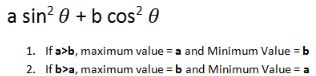
   Type III
Example -1  
Find the maximum and Minimum Value of 3 sin 2x + 4 cos 2x
Sol- Here the 4> 3 so
  •  Maximum Value = 4
  • Minimum Value = 3
Example –2
Find the maximum and Minimum Value of 5 sin 2x + 3 cos 2x
Sol - Here 5>3
  • Maximum Value = 5
  • Minimum Value = 3
Type-IV
 Find the Minimum Value of  Sec 2x +  cosec 2x
Sol - 1 + tan 2x +  cosec 2x    --------------------------------------------(Sec 2x = 1 + tan 2x)
= 1+ tan 2x + 1 +  cot 2x ------------------------------------------------(cosec 2x = 1 + cot 2x )
=2 + tan 2x +  cot 2x---------------------------------------------------apply type-3 formula
=2 + 2 √ 1 x  1 = 2 + 2 =4


Aptitude Important Notes & Short Tricks on Height & Distance

Important Notes & Short Tricks on Height & Distance

Today we will be covering a very important topic from the Advance Maths part of the Quantitative Aptitude section that is – Important Notes & Short Tricks on Height & Distance. 
Short Tricks on Height & Distance
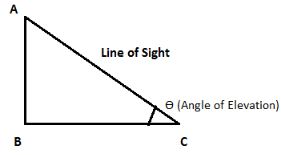
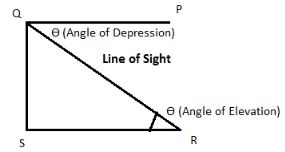
Angle of Elevation: Let AB be a tower/pillar/shell/minar/pole etc.) standing at any point C on the level ground is viewing at A.
The angle ,which the line AC makes with the horizontal line BC is called angle of elevation .so angle ACB is angle of elevation.
Angle of Depression: If observer is at Q and is viewing an object R on the ground ,then angle between PQ and QR is the angle of depression .so angle PQR is angle of depression.
Numerically angle of elevation is equal to the angle of depression.
Both the angles are measured with the horizontal.
Previous year Questions based on Height & Distance asked in SSC CGL Exam and SSC CGL Tier II Exam.
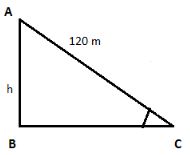
  1. The thread of a kite is 120 m long and it is making 30° angular elevation with the ground .What is the height of the kite?
Solution:
Sin 30° = h/120
1/2 = h/120
h = 60m
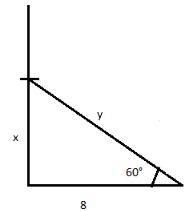
  1. A tree bent by the wind .The top of the tree meets the ground at an angle of 60°.If the distance between the top of the foot be 8 m then what was the height of the tree?
Solution:
tan 60° = x/8
√3 = x/8
x = 8 √3
y cos 60° = 8/y
1/2 = 8/y
y = 16
therefore height of the tree = x+y
= 8√3+16
= 8(√3+2)
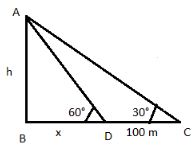
  1. The angle of elevation of the top of a tower from a point on the ground is 30° . On walking 100m towards the tower the angle of elevation changes to 60° . Find the height of the tower.
Solution:
In right triangle ABD,
tan 60° = h/x
√3 x = h
x = h/√3
Again , in right triangle ABC ,
tan 30 = h/x+100
1/√3 = h/x+100
√3 h = x+100
√3 h = h/√3 + 100
√3 h – h/√3 =100
3 h - h/√3    =100
2 h = 100√3
h = 50√3
By short trick:
d = h (cot Ɵ1 - cot Ɵ2)
h = 100/(√3-1/√3) = 100*√3/2 = 50√3
Ɵ1 = small angle
Ɵ2 = large angle
d = distance between two places
h = height
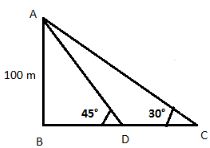
  1. From the top of a temple near a river the angles of depression of both the banks of river are 45° & 30°. If the height of the temple is 100 m then find out the width of the river.
Solution:
tan 45° = AB/BD
1 = 100/BD
BD = 100
tan 30 ° = AB/BC
1/√3 = 100/BC
BC = 100 √3
Width of the river , CD = BC - BD = 100 (√3-1)
When height of tower is 1 m then width of river is √3-1
Since height of tower is 100 m
Therefore ,
Width of river is 100(√3-1)m
By short trick:
Same formula can be used in this question too i.e.
d= h (cot Ɵ1 - cot Ɵ2)
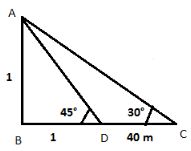
  1. The angle of elevation of the top of a tower from a point is 30 °. On walking 40 m towards the tower the angle changes to 45°.Find the height of the tower?
Solution:
tan 45° = AB/BD
1 = AB/1
Therefore AB = 1
tan 30° = AB/BC =>1/√3 = 1/BC
therefore BC= √3
Now CD =√3-1 m and height of tower is 1 m
1 m = 1/√3-1
Therefore 40 m  = 1/√3-1.40 = 40/√3-1
= 20 (√3+1)m
By trick:
40 = h(√3-1)
H  = 40/(√3-1) = 20 (√3+1)m