AIMS DARE TO SUCCESS MADE IN INDIA

Saturday, 6 January 2018

Reasoning Distance & Direction Shortcut Tricks

Distance & Direction Shortcut Tricks

As the name of the topic clearly explains that we deal with finding distance or direction in the questions of this topic. But for dealing with the questions from this topic, we must have very clear idea about two things.
  • Basic Directions
  • Pythagoras theorem
1. Basic Directions: We have 8 basic directions which should be crystal clear to us for attempting distance and direction questions.
One key point that should be kept in mind is that If not mentioned we always assume that the person is facing north.
2. Pythagoras theorem: According to this theorem,” The square of Hypotenuse is always equal to the sum of the squares of the other two sides of the right angle triangle”.
Suppose we have a triangle having base p, height q and hypotenuse r. Then according to this theorem:
p2+q2=r2
Now you have the basics required to atttempt Distance & Direction questions. So let us try to look at few questions on the same so that you will get to know the proper approach to solve these questions.

Some other basics:

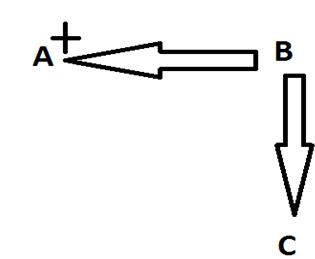
1.B is to the east of A.
2. B is to the west of A.
3. B is to the north of A.
4. B is to the south of A.

5. B is to the North East of A.
6. B is to the North West of A.
7. B is to the South East of A.
c7
8. B is to the South West of A.
Direction: Ashok started walking towards South. After walking 50 meters he took a right turn and walked 30 meters. He then took a right turn and walked 100 meters. He then took a left turn and walked 30 meters and stopped. How far and in which direction was he from the starting point?
Solution:
Ashok started walking towards south.
After walking 50 meters...
..he took a right turn…
Some people have doubt in deciding left or right in direction questions; they can replace right by clockwise and left by anticlockwise. So now moving right (clockwise) from the tip of the arrow.
…and walked 30 meters.
He took a right turn…
…and walked 100 meters.
He took a left turn…
…and walked 30 meters.
Now for finding how far he has moved, we will check two things:
  • Horizontal displacement
  • Vertical displacement
Horizontal displacement = 30+30 = 60m
Vertical displacement = 100-50 = 50m
Final displacement = √(602+502) = √(3600+2500) = √6100 = 10√61 m
Now for finding the direction with reference to initial position, we will draw a line joining two points which will give us the direction.
We can clearly see that the direction in which Ashok moved is northwest.
So the final answer for this question will be “Ashok moved 10√61 meters in northwest direction”.
Directions: Jay starts his van from point X and covers a distance of 10 km towards west, then he turns north and covers a distance of 7 km. Again, he takes a right turn and covers 25 km. Now he covers 6 km, after taking a left turn. At last he takes a left turn and covers 15 km and stops at point Z.
Solution:
Jay starts his van from point X and covers a distance of 10 km towards west
then he turns north
and covers a distance of 7 km
Again, he takes a right turn
…and covers 25 km
Now he covers 6 km, after taking a left turn.
At last he takes a left turn…
…and covers 15 km and stops at point Z.
Q. Towards which direction was the van running before stopping at point Z?
  1. North
  2. East
  3. West
  4. South
  5. None of these
Solution: We can clearly see that van was running towards west before stopping at point Z.
So the correct answer is C.
Q. How far is Jay from point X?
  1. 23 km
  2. 25 km
  3. 17 km
  4. 50 km
  5. None of these
Soution:
Horizontal movement = 10-25+15 = 0 kms
Vertical movement = 7+6 = 13 km
So final movement = = √(02+132) = √169 = 13 km
Direction of movement is North.
Key points related to Distance & Direction:
  • Always remember the basic directions.
  • Pythagoras theorem is valid only for a right angle triangle.
  • Always approach the question step by step.
  • In the End, join the initial and final point to get to know the distance and relative direction.
  • If in any of the questions, the relative direction is given.i.e. P is to the north of Q, then you can use the basic directions to get the location of P and Q.


Reasoning Concept of Coding Decoding & its Important Shortcuts

Concept of Coding Decoding & its Important Shortcuts

Tips:

➀ Try to focus on the thinking behind the solution.

Example 1: If GLORIOUS is coded as GOLRIOSU, code ‘JUDICIAL’?
Solution: This doesn’t need any explanation. A simple question based on observation.
As G L O R I O U S is coded as G O L R I O S U, we are that second and third letters are interchanged, again last two letters are also interchanged as shown below.
Using the same logic, the word J U D I C I A L is coded as J D U I C I L A
Example 2: If PEN is written as ‘+X’ and ENT is written as ‘X–’ in a certain code, how is TEN written in the same code? 
Solution: The first thing to notice is that PEN has three characters while +X has only two. So two characters of PEN have been replaced by a single character. The same pattern can be seen in the case of ENT.
We must look for something common in the two of them PEN and ENT.
PEN = “+X”
ENT = “X–”
Common feature in both the above are EN & X. 
So P = +, EN = X & T = –
TEN = –X

   LETTER CODING:

Here letters are assigned codes according to a set pattern or rule concerning the movement or reordering / rearranging of letters and you need to detect this rule to decode a massage. Sometimes, specific codes are assigned to particular letters without any set pattern. Observe a few examples to know the various reordering or rearranging techniques.
Direction for example 3: In these questions the real alphabets in a word are replaced by certain other alphabets according to a specific rule to form its code.
Example 3: In a code language if TRAINS is coded as RTIASN, how PISTOL will be coded in the same language?
(a) SITLOP
(b) IPSTLO
(c) SIPTLO
(d) IPTSLO
Solution: If we compare the basic word {TRAINS} with the coded word {RTIASN}, we would see that the letters used in the word are same as in the basic word but their order of placement has been changed. Letter T at first position of the basic word has been placed at second position in the coded word and the letter R at the second position has been placed in the first position.
It means that in this question, letters of the basic word have been interchanged i.e. first letter with second, third with the fourth and so on. And thus we get the coded word. So PISTOL will be coded as IPTSLO. Hence option (d) is the answer.

➂ NUMBER CODING: 

Numerical code is given or value is assigned to a word. Here the only way to relate the alphabets & numbers is by associating the positions of the letters in the English alphabet. Sometimes any mathematical operation like addition or subtraction can be performed using the position of the letters. Direct coding questions can also be asked.
Direction for example 4: In this question, either numerical code values are assigned to a word or alphabetical code letters are assigned to the numbers.
Example 4: If PAINT is coded as 74128 and EXCEL is coded as 93596, then how would you encode ACCEPT?
(a) 455978
(b) 547978
(c) 554978
(d) 735961
Solution: In the given code the alphabets have been coded as follows:
P     A     I     N     T     E     X     C     L
7     4     1     2     8     9     3     5     6
So, in ACCEPT, A is coded as 4, C as 5, E as 9, P as 7 and T as 8. Hence the correct code is 455978 and therefore the answer is Choice (a).

➃ MIXED LETTER/NUMBER CODING: 

Some messages are given in the coded language and the code for a particular word or message is asked. To analyze such codes, any two messages bearing a common word are picked up. The common code number are picked up. Proceed in the similar fashion by picking up are possible combination of two, the entire message can be decoded.
Example 5: If ‘tee see pee’ means ‘drink fruit juice’; ‘see kee lee’ means ‘juice is sweet’ and ‘lee ree mee’ means ‘he is intelligent’, which word in that language means ‘swee’?
(a) see
(b) kee
(c) lee
(d) pee
Solution: In the first and second statement, the common word is ‘juice’ and the common code word is ‘see’. So, ‘see’ means ‘juice’.
In the second and third statements, the common word is ‘is’ and the common code is ‘lee’. So ‘lee’ means ‘is’. Thus in the second statement, the remaining word ‘sweet’ is coded as ‘kee’. Hence the answer is choice (b).
Example 6: In a certain code, ‘786’ means ‘study very hard’, ‘958’ means ‘hard work pays’ and ‘645’ means ‘study and work’. Which of the following is the code for ‘very’?
(a) 8
(b) 6
(c) 7
(d) Cannot be determined
Solution: Based on the same logic as used in the above question, the code for ‘very’ can be found out to be ‘7’, hence the answer is choice (c).

 ➄ Coding decoding questions can also be asked in following types, these types were recently asked in SBI Exam and it puzzled many students. But if you read the instructions carefully and practice it, you can easily solve it. 

Type: Symbols and Places of Digits
Example 6 : Triangle represents ∆ (1) and circle represents ○ (0). If triangle appears in unit's place then only its value is 0. If it appears in 10's place its value is 1 and when it appears in 100’s place is doubled to 2 like that it continues. Questions based on this
For example:
∆ ○ =0+0=0
∆○∆∆∆= 8+0+2+1+0=11
6.1. How will you represent ‘29’ in this code language?
(a) ∆∆∆○∆∆
(b) ○○∆∆∆○○
(c) ∆∆∆∆∆∆○
(d) ∆○∆○∆○∆
(e) ∆○∆∆○○ ○
Solution: (a)
∆∆∆○∆∆ = 16+8+4+0+1+0=29
6.2. What will be the code for  ○∆○∆○∆○ ?
(a) 12
(b)74
(c)21
(d)16
(e)4
Solution: (c)
○∆○∆○∆○ = 0+16+0+4+0+1+0=21
Type : (Tabular) Coding based on Conditions
Example 7: In each question below is given a group of numbers separated by comma (,). They are followed by four combinations of letters/symbols numbered (1), (2), (3) and (4). You have to find out which of the given combinations correctly represents the group of numbers based on the following coding system and mark the new code of that combination as the answer. If no condition is applicable coding will be according to the table.  If none of the four combinations correctly represents the group of numbers, mark ‘None of the above’, as the answer.

Conditions:
1) If the first number is a prime and the last number is a composite number then their codes are to be interchanged. 
2) If both the first and the last number is Prime both are to be coded as $.
3) If both the first and the last letters are Composite and in between there are two
or more Prime numbers then Prime numbers are to be coded as A.
4) If the first number is composite and the last number is a prime number, both are to be coded as the code for the composite number.
7.1.  4, 17, 88, 16, 3
(a) #,K,&,$,#
(b) A,K,&,$,#
(c) A,K,&,$,A
(d) $,K,&,$,$
(e) None of the above.
Solution: (a)
In 4,17,88,16,3 the first number is a composite and last is a prime; so codes will be according to condition (4).
7.2.  44, 11, 4, 2, 8
(a) $,S,#,C,$
(b) A, S,#,C,A
(c) B, S,#,C,@
(d) @,S,#,C,B
(e) None of the above
Solution: (d)
Given set of numbers are 44,11,4,2,8, here both first and last numbers are composite and there is only one prime number in between them. Hence no condition will apply and the codes are according to the given symbol table.


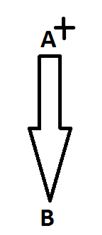
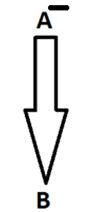
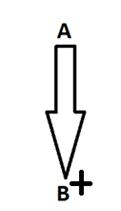
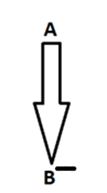
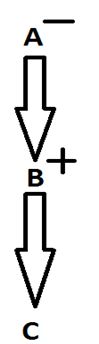
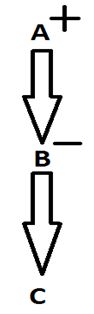
Reasoning Blood Relation Tips and Trick We always use + sign for male.

Blood Relation Tips and Trick

We always use + sign for male.
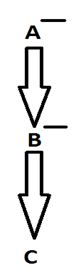
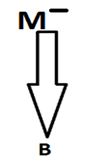
We always use – sign for female.
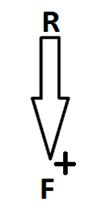
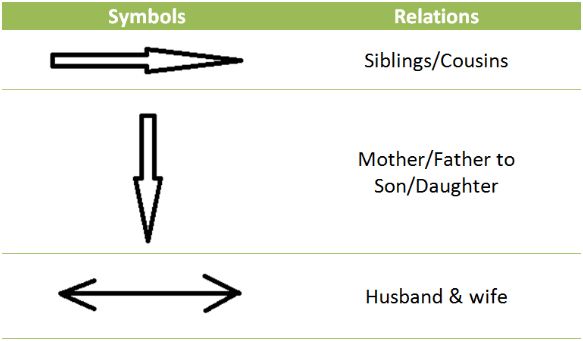
  • To show the relation from one generation to another (Mother/Father to Son/Daughter), we use single arrow head.
  • To show the relation within the same generation (siblings/cousins), we use single arrow head.
  • To show the relation between husband & wife, we use double arrow head.
Let us see symbolic representation of various blood relations:
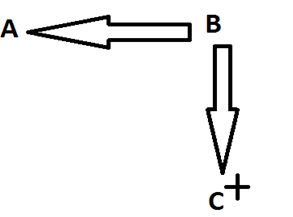
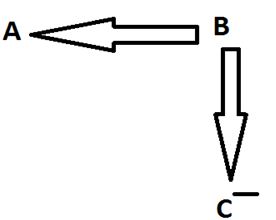
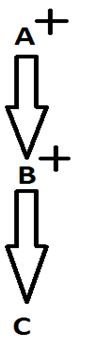
1. A is the father of B: Here we know the gender of A only. B can either be son or daughter.
2. A is the mother of B: Here we know the gender of A only. B can either be son or daughter.
3. B is the son of A: Here we know the gender of B only. A can either be father or mother.
4. B is the daughter of A: Here we know the gender of B only. A can either be father or mother.
5. B is the wife of A: Here we know the gender of both A and B.
6. A is the husband of B: Here we know the gender of both A and B.
7. A is the uncle of C: Here we know the gender of A only. B & C can be either male or female.
8. A is the aunt of C: Here we know the gender of A only. B & C can be either male or female.
9. C is the nephew of A: Here we know the gender of C only. A & B can be either male or female.
10. C is the niece of A: Here we know the gender of C only. A & B can be either male or female.
11. A is the paternal grand-father of C: Here we know the gender of A and B both.
12. A is the paternal grandmother of C: Here we know the gender of A and B both.
13. A is the maternal grandfather of C: Here we know the gender of A and B both.
14. A is the maternal grandmother of C: Here we know the gender of A and B both.
Blood relation questions can be asked in two different ways.

Type I: In this case, the blood relation is not coded.

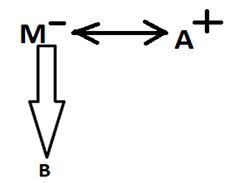
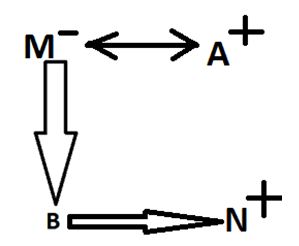
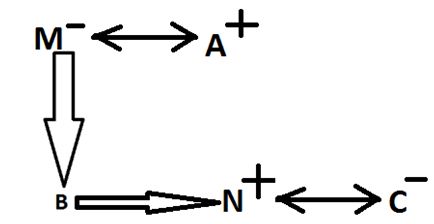
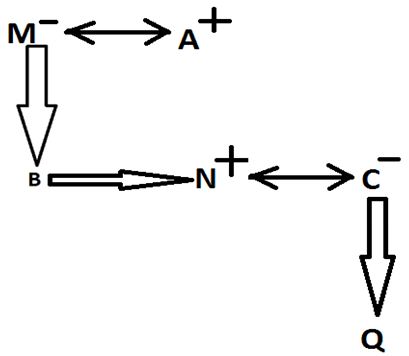
Direction: M is the mother of B. A is the husband of M. N is the only brother of B. C is married to N. Q is the only child of C. N does not have any sister. J is the father of A.

Solution:
M is the mother of B.
A is the husband of M.
N is the only brother of B.
C is married to N.
Q is the only child of C.
N does not have any sister (Which means B is definitely his brother).
J is the father of A.
Q.1) If A doesn’t have any grandson, then how is Q related to B?
  1. Can’t be determined
  2. Sister-in-law
  3. Daughter-in-law
  4. Niece
  5. Nephew
Solution: We can see that Q is either the grandson or granddaughter of A. But as per the question, A doesn’t have any grandson which definitely assures that Q is A’s granddaughter. So Q is B’s niece.
Q.2) How is A related to C?
  1. Uncle
  2. Can’t be determined
  3. Father-in-law
  4. Nephew
  5. Brother-in-law
Solution: A is N’s father and C is N’s wife. So A is the father-in-law of C.
Q.3) How is B related to J?
  1. Father
  2. Nephew
  3. Brother-in-law
  4. Brother
  5. Grandson
Solution: B is the son of J’s son. So B is the grandson of J.

Type II: In this case, the blood relation is coded.

Directions: Read the following information carefully and answer the question which follows:
‘A*B’ means A is the son of B.
‘A+B’ means A is the father of B.
‘A>B’ means A is the daughter of B.
‘A<B’ means A is the wife of B.
Q.4) What will come in place of the question mark (?), if it is provided that M is the grandmother of F in the expression ‘F*R<S?M’?
  1. >
  2. <
  3. +
  4. *
  5. Can’t be determined
Solution: F*R means F is the son of R.
R<S means R is the wife of S.
M is the grandmother of F (given already) which means M is either mother of S or R. So we can’t determine the answer for this questions using given options. So the answer is 5.
So we have seen two different ways in which blood relation questions can be asked. Sometimes blood relation concept is used in sitting arrangements as well to make those questions more tough. That application of blood relations will be discussed in basics of sitting arrangement.

Key points related to blood relations:

  • Never assume any person to be male or female if not specified in the question.
  • Step by step approach can always give the solution for blood relation questions, doesn't matter the question is coded or simple one.


Reasoning 3 Types Of Symbols & Notations Based Problems

3 Types Of Symbols & Notations Based Problems

Type I: Interpretation of Symbols

In type 1, you will find symbols and their corresponding meanings. You have to find the answer based on the question data.
Below example will help you understand better.
Example Question 1: If A @ B means ‘A is the mother of B’, A # B means ‘A is the brother of B’, A * B means ‘A is the sister of B’, A % B means ‘A is the father of B’, then which of the following indicates the relationship R is the grandmother of Q?
a) R @ P * S % Q
b) P @ R % S * Q
c) P $ R @ S * Q
d) R * Q $ S # P
Solution:
You can solve these problems by checking the options one by one.
Let us consider option a) R @ P * S % Q
R @ P – R is the mother of P
P * S – P is the sister of S
S % Q – S is the father of Q
From these 3 statements, we can write that R is the mother of P and S and S is the father of Q.
Therefore, R is the grandmother of Q.
Thus option a) is the answer. (In case, if it did not match you have to check each option in the same way to find the answer.)
Hence, the answer is R @ P * S % Q.


Type II: Replacement Type of Problems

In this type, you will be given replacements for symbols. You have to make similar replacements in given expression to find the answer. Below example will help you.
Example Question 2: If ‘+’ means ‘x’, ’x’ means ‘-‘, ‘-‘ means ‘÷’, ‘÷’ means ‘+’, then find the value of 18 – 3 + 2 x 8 ÷ 2.
Solution:
Given expression: 18 – 3 + 2 x 8 ÷ 2,
After changing the signs (based on question data) , the above expression becomes
18 ÷ 3 x 2 – 8 + 2
By applying BODMAS rule we get,
6 x 2 – 8 + 2
12 – 10
= 2


Type III: Directions and Distances Representation

In this type, symbols will represent distance in a particular direction. Based on the data in question, you have to compute the answer. Below is an example.
Example Question 3:
A * B means B is to the East of A at a distance of two units.
A # B means B is to the South of A at a distance of one unit.
A @ B means B is to the West of A at a distance of two units.
A $ B means B is to the North of A at a distance of two units.
If P $ Q # R @ S, then S is in which direction with respect to P?
Solution:
P $ Q – Q is in North to P with a distance of 2 units.
Q # R – R is in South to Q with a distance of 1 unit.
R @ S – S is in West to R with a distance of 2 units.

Reasoning 5 Types Of Ranking & Time Sequence Problems

5 Types Of Ranking & Time Sequence Problems

Type I: Finding Rank From the Start (or the End)

In type 1, you will know the rank of a person from either the start (or the end). Using that data, you have to find the rank of that person from the end (or the start). Below example will help you.
Example Question 1: Reena is 10 ranks ahead of Priya in a class of 40. If Priya`s rank is 20th from the last, what is Reena`s rank from the start?
Answer: 31th
Solution:
Priya’s rank from the last is 20. Reena is 10 ranks ahead. Therefore, Reena’s rank from the last = Rank of Reena from the last = 20 – 10 = 10th
Now you have to apply the formula that you saw in the introduction.
Total number of students = Rank of Reena from the start + Rank of Reena from the end – 1
40 = Rank of Reena from the start + 10 – 1
Rank of Reena from the start = (40 – 10) +1
= 31th


Type II: Finding Total Number of People in a Sequence

In type 2, you will find ranks of a person from the start and the end. You have to find the total number of people. Let us see an example.
Example Question 2: Venkatesh ranks 8th from the top and 24th from the bottom in the class. How many students are there in total?
Answer: 31
Solution:
Total number of Students = Rank of Venkatesh from the top + Rank of Venkatesh from the bottom – 1
= [8 + 24] – 1= 31


Type III: Interchanging Positions
In this type, positions of the people in a sequence will be interchanged. You have to solve these problems after processing the data given.
Example Question 3: In a row of girls, Uma is 10th from the left and Meena is 20th from the right. If they interchange their positions, Uma becomes 15th from the left. How many girls are there in the row?
Answer: 34
Solution: 
After interchange, rank of Uma from the left = 15
But, before interchange, Meena was 20th from the right. After interchange, Uma would have occupied the same position of Meena’s
earlier spot. Therefore,
Present rank of Uma from the right = 20
Now you know the current ranks of Uma from left as well as right. Therefore,
Total number of girls = Uma’s rank from the left + Uma’s rank from the right – 1
= (15+20)-1
=34.


Type IV: Intervention in a Frequent Event

Though the heading of this type looks complicated, this is one of the easiest. There will be intervention at certain time of a frequent event. Based on that time data you have to solve the problem logically.
Let us see an example.
Example Question 4: A bus leaves to Chennai from Bangalore every 30 minutes. A passenger inquired about the next bus to Bangalore, and he was informed that the bus left 15 minutes before, and the next bus will be at 5.00 pm. Find at what time the passenger had enquired?
Answer: 4.45 pm
Solution:
For every 30 minutes, there is a bus. The next bus will be at 5.00 pm, so the last bus must have left at 4.30 pm. 
The informer said that the bus had left 15 minutes before his inquiry. So the time of inquiry is 4.30 + 0.15 = 4.45 pm.


Type V: Day of Week Based on Frequency

This type is very easy just like the previous one. You can answer this with little effort. (You may not expect questions simple in your exam. However, this will be a first step in understanding more difficult questions.)
Example Question 5: Gita went to the temple five days ago. If she goes to the temple every Friday, then what day of the week is today?
Answer: Wednesday
Solution: 
She went to temple five days ago i.e., Friday.
Five days from Friday is Wednesday.

Reasoning 2 Types Of Inequality Problems

2 Types Of Inequality Problems

Type 1: Interpretation of Expression

In type 1, you have to interpret a given expression. Then you have to find which option satisfies the expression. Below is an example.
Example Question 1: Which of the following expression will be true if the expression P>Q=R<S is definitely true?
a) P > R   b) P = R   c) P > S   d) Q > S
 
Answer: a) P > R
 
Reason:
The given expression is,
P > Q = R < S
Here Q and R are equal.
So if P is greater than Q, then P will also be greater than R. Hence option a is true.


Type 2: Symbol Mapping

In the question, you will find symbols and their meanings. You have to replace the symbols with their signs to form an expression. Based on the expression you have to answer the following questions.
Below is an example to help you understand.
Example Question 2: In the following question, the symbols @, §, =,*,δ are used with the following meanings:
‘P@Q’ means ‘P is greater than Q’;
‘P§Q’ means ‘p is greater than or equal to Q’;
‘P=Q’ means ‘P is equal to Q’;
‘P*Q’ means ‘P is smaller than Q’;
‘PδQ’ means ‘P is smaller than or equal to Q’;
Now in each of the following questions, assuming the given statements to be true, find which of the two conclusions I or II is/are definitely true.
Give answer (a) if only conclusion I is true;
Give answer (b) if only conclusion II is true;
Give answer (c) if either conclusion I or II is true;
Give answer (d) if neither conclusion I or II is true;
Give answer (e) if both conclusion I and II is true;
1. Statements:
S*M, M@L, L§Z
 
Conclusions:
1. S=Z    2. SδL
 
Options: a, b, c, d, e
 
Answer: d) neither conclusion I or II is true
 
Reason:
Given Statements are S*M, M@L, L§Z
We can convert the statements as follows:
S*M – S is smaller than M (i.e.) S<M;
M@L – M is greater than L (i.e.) M>L;
L§Z – L is greater than or equal to Z (i.e.) L≥Z;
Combining the above we get the expression:
S<M>L≥Z
Now we have to check the given conclusions with the expression we got above.
Given conclusions are:
1. S=Z     2.S*L (i.e.) S≤L
We cannot compare S and Z. So conclusion I is not true
Similarly, S and L also cannot be compared. So conclusion II is also false
Hence, neither conclusion I nor II is true.
2. Statements:
J=V, V*N, RδJ
 
Conclusions:
1. R*N     2. J§N
 
Options: a, b, c, d, e
 
Answer: a) only conclusion I is true
Reason:
Given statements are J=V, V*N, RδJ
We can convert the statement as follows:
J=V – J is equal to V;
V*N – V is smaller than N (i.e.) V<N
RδJ – R is smaller than or equal to J (i.e.) R≤J
Combining the above, we get the expression:
J = V < N, R ≤ J
i.e., R ≤ J = V < N

Given conclusions are:
1. R*N (i.e.) R<N    2. J§N (i.e.) J≥N
As per the equation R≤J = V<N
R<N is true (i.e.) conclusion I is true
From our expression we can write J = V < N. Because J=V, J should also be lesser than N.
Therefore, J < N.
But our conclusion says, J≥N.
So conclusion II is false.
Hence conclusion I is true.

Reasoning 3 Types Of Coding & Decoding Problems

3 Types Of Coding & Decoding Problems

Type I: Coding Based on Jumbling the Letters

In type 1, encoding is done by jumbling/rearranging the letters of the given word. Below example will help you understand this easy type.
Example Question 1: In a certain code language, RESEARCH is written as ESERHCRA. How you will code the word TEACHING be in the same code language?
Solution:
The logic used to code the word RESEARCH is as follows.
First, the word RESEARCH is divided into two Halves as, RESE | ARCH.You have to reverse first half letters as ESER and second half letters as HCRA. Then if you combine the words you will get, ESERHCRA.
Similarly, if you use the same logic, TEACHING can be coded as CAETGNIH.


Type II: Coding Using Preceding/Following Letters

In type 2, you have to encode based on preceding or following letters. Below example will help you to understand this type well.
Example Question 2: In a certain code language LAPTOP is written as QBMONS. How will you code the word SOLVED in that language?
Solution:
The logic used to code the word LAPTOP is as follows.
First, divide the word into two halves, LAP | TOP.
The first half letters are incremented by 1 and second half letters are decremented by 1.
Then after reversing the letters, they are combined as QBMONS.
Similarly, the word SOLVED can be coded as MPTCDU.


Type III: Coding By Substituting The Complete Word

In type 3, the codes are based on replacing the complete word with a new word. Here is an example.
Example Question 3: Directions(1 – 4) In a certain code language “ki na se”means “Today is Sunday”, “ri se na” means “Sunday is holiday”, “ta ri”means “Enjoy holiday”.
Sub-question 1. What is the code used for “Sunday”?
Solution:
Codes given in the question are as follows.
“Ki   na   se”   – “Today   is   Sunday”   …(1)
“Ri   se   na”   – “Sunday   is   holiday”   …(2)
“Ta   ri”   – “Enjoy   holiday”   …(3)
Below are 2 inferences which will help you answer all the sub-questions.
 
(i) Inference from equations (2) and (3):
In (2) and (3), only word that occurs in both the coding equations is “holiday” and only code that occurs in both the equations is “Ri”.
Therefore, you can conclude, “Ri” – “holiday”.
(ii) Inference from equations (1) and (2):
In (1) and (2), words that occur in both the coding equations are “is” and “Sunday” and only codes that occur in both the equations are “Na” and “se”.
Therefore, you can say among “Na” and “se” should be “is” and other should be “Sunday”.
Also you can infer the following from (1) and (3).
“Ki” – “Today”
“Ta” – “enjoy”
Here is your answer to sub-question 1: The code used for the word “Sunday” is either “na/se”.
Sub-question 2. How will you code the word “Enjoy Sunday”?
Solution:
The code for “Enjoy” is “ta” and for “Sunday” is either “na/se”.
So the code for “Enjoy Sunday” may be either “ta na” or “ta se”.
Sub-question 3. What does the code “ri” stand for?
Solution:
The code “ri” stands for “Holiday”.
Sub-question 4. What is the code for the word “Today Holiday”?
Solution:
The code for “Today” is “ki” and for “holiday” is “ri”.
So the code for the word “Today holiday” is “ki ri”.

Reasoning Easily Solve 3 Types Of Blood Relationship Problems

Easily Solve 3 Types Of Blood Relationship Problems

Type I: First Person Narration Type

This type is the easiest type of blood relationship problems. In this model, a person will narrate how another person is related to him. You have to identify the relationship between both of them.
You can easily solve this by thinking logically. Below example will help you to understand better.
Example Question 1: Pointing to a man, Anu said, “He is the only son of my grandmother’s only daughter.” How is the man related to Anu?
a) Cousin
b) Niece
c) Brother
d) None of these
 
Answer: c) Brother
Reason:
Anu’s grandmother’s only daughter is Anu’s mother.
The only son of Anu’s mother is Anu’s brother.


Type II: 2-3 Multiple Conditions Type

This type is the most common in this topic. In this case, 2-3 conditions will be given in the question. You have to find the answer based on those conditions. This type is straightforward and easy like type 1.
Here is your example.
Example Question 2: Hari and Asha are married couples. Arun and Ram are brothers. Arun is the brother of Asha. How is Hari related to Ram?
a) Brother-in-law
b) Brother
c) Cousin
d) Niece
 
Answer: a) Brother-in-law
Reason:
From the question, we can infer that Arun is a brother to both Ram and Asha. So Ram is also brother to Asha. Hence, Hari is brother-in-law to Ram.


Type III: Multiple (Usually Greater Than 3) Conditions Type

This type is similar to type 2, but you will find a lot of conditions (usually greater than 3). A good method to solve this type is by drafting diagrams. Below example will help you.
Example Question 3: Ravi is grandfather to Selvi. Balu is son of Ravi. Neetu is wife of Balu. Balu is brother of Kavi. Lakshmi is mother of Kavi. Selvi is daughter of Neetu. How is Lakshmi related to Neetu?
a) Sister
b) Mother
c) Mother-in-law
d) Aunt
 
Answer: c) Mother-in-law

Reasoning 3 Types Of Puzzles

3 Types Of Puzzles

Type 1: Classification Type of Puzzles

In this type, you have to form a table and plot the information given in the question. Based on your table, you can quickly answer all the sub-questions. (Usually, these types of questions will have more than one sub-questions just like data interpretation problems.)
Below is your example question. This problem will help you in understanding better.
Example Question 1: Study the following information carefully and answer the questions that are given below:
Mahesh and Siva are good in French and English
Anu and Baskar are good in English and Japanese
Anu, Kishore and Raju are good in Japanese and Hindi
Raju and Latha are good in Japanese and Chinese
Kishore and Siva are good in Hindi and French
i. Who is good in Chinese, Japanese and Hindi?
a) Anu b) Kishore c) Raju d) Siva
 
Answer: c) Raju
Reason:
If you create a table based on the question information, you will get the one below.
Name    French    English    Japanese    Chinese    Hindi
Mahesh    ✓         ✓            
Siva    ✓         ✓                              ✓
Anu                 ✓            ✓                  ✓
Baskar             ✓            ✓        
Kishore     ✓                    ✓                  ✓
Raju                        ✓          ✓          ✓
Latha                        ✓          ✓    
From the table, we can say Raju knows Japanese, Hindi and Chinese.
For the below sub-questions, you do not have to solve from the start. You can answer just by looking at the table you already created.
ii. Which pair is good in French and Hindi?
a) Siva and Latha b) Kishore and Baskar
c) Siva and Raju d) Siva and Kishore
 
Answer: d) Siva and Kishore
iii. Who is good in French, Hindi and not in English?
a) Mahesh b) Anu c) Raju d) Kishore
 
Answer: d) Kishore
iv. Who is not good in French, Chinese and Hindi?
a) Baskar b) Mahesh c) Raju d) Siva
 
Answer: a) Baskar
v. Which of the following pair is good is in French and Japanese?
a) Mahesh and Baskar b) Kishore and Anu
c) Raju and Siva d) None of these
 
Answer: d) None of these
Reason: 
Kishore is the only person who is good in both French and Japanese. In the question, they have asked to find a pair. So the answer is
none of these.


Type II: Comparison Type Questions
In type 2, you will find a comparison between two or more people. For example, the comparison could be in the order of strength, height, age, etc. You have to apply the data to get the correct order. Once you have obtained the right order, you can answer all the following questions, quite quickly.
Here is your example.
Example Question 2: Read the following information and answer the questions given below:
Among five friends, Ravi is stronger than Mohit but weaker than Rohit.
Mani is the strongest.
Prem is stronger than Mohit and weaker than Ravi.
i. Who is the weakest person?
a) Mani b) Prem c) Rohit d) Mohit
 
Answer: d) Mohit
Reason:
From statement 1, Rohit > Ravi > Mohit
From Statement 2, Mani > Rohit > Ravi > Mohit
From Statement 3, Ravi > Prem > Mohit
Hence, the final arrangement is
Mani > Rohit > Ravi > Prem > Mohit

ii. Who is the second strongest person?
a) Ravi b) Mohit c) Rohit d) Mani
 
Answer: c) Rohit


Type III: Sequential Order of Events
In type 3, you will be ordering events in sequence. You have read the conditions carefully, work out the possibilities and arrive at a logical conclusion.
Now let us go to the example questions.
Example Question 3: Study the following information carefully and answer the questions that follow:
In an inter-school event, competitions for Singing, Dancing, Verse Writing, Fancy Dress, Quiz and Debate have to be conducted for 5 days.
(a) Singing should not be conducted on Thursday.
(b) Verse Writing should be held immediately after Debate.
(c) There should be a gap of two days between Quiz and Fancy Dress.
(d) Dancing should be conducted on Tuesday and should not be followed by Fancy dress.
(e) Singing should not be followed by fancy dress.
i. Which program is to be conducted on Wednesday?
a) Singing b) Verse Writing c) Quiz d) Debate
 
Answer: c) Quiz
Reason:
From the statements, it is clear that Dancing is conducted on Tuesday.
Two days gap should be there between Quiz and Fancy dress. For this condition, two possibilities are there. One is Monday and
Thursday and the other is Wednesday and Saturday.
Verse-writing should have be followed by Debate. Here also two possibilities. One is Friday and Saturday and the other is Thursday and Friday.
Singing may be on either Monday or Wednesday.
There is another condition that is, Singing should not follow Fancy dress. If we take Monday and Thursday for Quiz and Fancy Dress,
Singing will be on Wednesday, and it will be followed by Fancy dress. Hence, our condition will not be satisfied.
So, we go for the other possibility and is given in below table.
Competition     Day
Singing      Monday
Verse Writing    Friday
Debate    Thursday
Quiz    Wednesday
Fancy Dress    Saturday
Dancing    Tuesday
Now, you have arrived at the order of the events. Therefore, you can answer any number of sub-questions quickly after that. Below are few sub -questions to help you understand better.
ii. Which Competition is conducted on Friday?
a) Debate b) Dancing c) Quiz d) Verse Writing
 
Answer: d) Verse Writing
iii. In which day fancy dress competition is conducted?
a) Monday b) Saturday c) Tuesday d) Wednesday
 
Answer: b) Saturday
iv. After which competition does Quiz is to be conducted?
a) Fancy dress b) Dancing c) Debate d) Singing
 
Answer: c) Debate
v. Which competition is to be conducted first?
a) Dancing b) Verse writing c) Debate d) Singing
 
Answer: d) Singing

Reasoning 3 Easy Types Of Classification Problems

3 Easy Types Of Classification Problems

Type I: Classification Based on Alphabet Positions

In this type, you will be able to classify the terms based on the position of the alphabets. You have to pick the odd man out which does not follow the rules. Below example will help you understand this.
Example Question 1: Four of the five are alike on the basis of their position in English alphabet. Which is the one that does not belong to the group?
a) BDF b) HJL c) NPS d) RTV e) VXZ
Solution:
This is a simple question. 
On seeing the logic used, you may find that the words are formed by incrementing every letter by 2 positions. 
i.e., B + 2 = D and D + 2 = F.
If you are not able to understand the above logic (rule), here is your explanation. D is 2 positions the right of D and F is 2 positions to the right of D.
But option c) NPS does not follow the above rule.
Except option c) all the other options use the same logic.


Type II: Classification Based on Meanings/Context

This type is similar to type 1, but all the options will be meaningful words. You have to find the odd option based on the meaning or context.
Below is your example question.
Example Question 2: Four of the five are alike in a certain way and so form a group. Which is the one that does not belong to the group?
a) Chalk b) Duster c) Board d) Class-room e)Book
Solution:
The odd one is class-room.
All other options given are used in class room.


Type III: Classification of Numbers

In this type, you will be able to classify/group numbers based on some numeric logic. You have to identify the number that does not follow the rule. You will understand better after reading the below example.
Example Question 3: Four of the five are alike in a certain way and so form a group. Which is the one that does not belong to the group?
a) 25 b) 49 c) 81 d) 121 e) 196
Solution:
All the options are square of numbers 5, 7, 9, 11 and 14 respectively.
Here except 14, remaining are odd numbers. Hence option e) is odd one.

Reasoning Learn 5 Types Of Alphabet Series Problems

Learn 5 Types Of Alphabet Series Problems

Type I: Word Formation From Letters of Another Word

In this type, you have to form words from specific letters of a given word. Next, you need to answer questions based on the new word/words formed. Below is an example.
Example Question 1: If it is possible to make a meaningful word with the fourth, the seventh, the eighth and the twelfth letters of the word “QUANTITATIVE”, which of the following will be the second letter of that word from the left end? If no such word can be made give ‘X’ as the answer and, if more than one such word can be made, give ‘M’ as the answer.
a) E b) M c) A d) X
Solution:
The given word is,
Q    U    A    N    T    I    T    A    T    I    V    E
1    2    3    4    5    6    7    8    9    10    11    12
Fourth letter in the word is – N
Seventh letter is – T
Eighth letter is – A
And twelfth letter is – E
The meaningful word you can form using the above letters is NEAT.
(Here, we can make only one word). So, the second letter from the left end is E.
Hence, the answer is Option a) E.


Type II: Letter Series

In this type, you have to find missing letters in a series. Let us see an example.
Example Question 2: What will come in the place of (?) in the following letter series?
EG, HJ, KM, NP, ?
Solution:
The letters in the series are formed by using the logic,
G is the second letter from E.
The second term (‘HJ’) starts with the successive letter of G, i.e., H. 
Below diagram will help you to understand the logic behind the series better.
  +2
E------G
   +2
H-------J
   +2
K-------M
   +2
N-------P
   +2
Q-------S
So the next letter in the series is QS. (Q is the next successive letter of P and S is the second letter from Q).


Type III: Identifying Letters That Match Given Conditions

In this type, you have to identify letters based on certain conditions given in the question. Here is an example.
Example Question 3: How many pairs of letters are there in the word “QUANTITATIVE” which have as many letters between them as in the English alphabet series?
Solution:
In the word, QUANTITATIVE you have to check for the pairs of letters that are in alphabet series.
In real alphabet series, the letters T and V have only one letter U between them.
In the word ‘QUANTITATIVE’ the letters T and V have only one letter I between them.
Therefore, TV is one such pair.
The other pair is AE. In the alphabet series, we have 3 letters between A and E., i.e., A, B, C, D and E.
Similarly, in the given word also, there are three letters between A and E.


Type IV: Arranging Words in Alphabetic Order

This type is the easiest of all. You have to arrange given words in alphabetical order and answer the corresponding questions.
Example Question 4: Arrange the following five words in alphabetical order as per dictionary then find which of the following word will come at the third place?
1) Music
2) Modern
3) Mobile
4) Manifest
5) Magic
Solution:
First, we have to arrange the words in dictionary (alphabetical) order.
First, check the first letter of the given words,
Words    Letters
Music    M
Modern    M
Mobile    M
Manifest    M
Magic    M
Here all the words start with the letter M. Therefore we have to move to the second letter to arrange in order.
Words    Letters
Music    U
Modern    O
Mobile    O
Manifest    A
Magic    A
Based on the second letter, the words can be arranged as,
Manifest
Magic
Modern
Mobile
Music
Here, the second letter of the words ‘Manifest’ and ‘Magic’ are same. Similarly, for ‘Modern’ and ‘Mobile’ the second letters are the same. In order, to find the proper arrangement we have to check with the third letter of these words.
Words    Letters
Manifest    N
Magic    G
Modern    D
Mobile    B
Now the arrangement is,
Magic
Manifest
Mobile 
Modern
Music
The word that comes at the third place is ‘Mobile’.


Type V: Arrangement of Letters and Interpretation

In this type, you will find conditions based on which you have to arrange letters. Then you have to answer the questions based on the new arrangement. Below example will help you to understand clearly. (There are 3 sub questions to the below one.)
Example Question 5: Directions (i- iii) Read the following information carefully and answer the questions given below:
ABCDEFGHIJKLMNOPQRSTUVWXYZ
Write the first 10 letters of above alphabets in reverse order, followed by next 6 letters, followed by remaining 10 letters in reverse order.
(i). Which letter will be the thirteenth to the right of the third letter from right?
 
Solution to sub-question (i):
First, we have to arrange the letters based on the condition given.
Step 1 : Arrange first 10 letters in reverse order.
JIHGFEDCBA
Step 2: Next 6 letters should be followed as it is,
JIHGFEDCBAKLMNOP
Step 3: The remaining 10 letters should be reversed
JIHGFEDCBAKLMNOPZYXWVUTSRQ
Now, we have arranged the alphabets according to the question.
Next, we have to find the thirteenth letter right to the third letter from your right. 
The required letter is K.
(ii). Four of the following five are alike in a certain way and form a group. Which is the one that does not belong to the group?
a) FDA b) LNZ c) PYV d) OZX e) WUR

Solution to sub question (ii):
In the arrangement we just created. (refer to diagram in sub-question (i))
Consider the first option ‘FDA. Here, D is the second letter from F and A is the third letter from D. The same logic is used to form all the
terms except option d) OZX. 

(iii). How many letters are there in between letters F and O in the sequence?

Solution to sub-question (iii):
Based on our arrangement diagram (refer to the diagram in sub-question (i)), the letters in the sequence are,
F    E    D    C    B    A    K    L    M    N    O
The number of letters between F and O is 9.

Reasoning Input Output

Input Output


In this input output method we are supposed to imagine that input is fed to machine . Machine process the input and arrange the input in each step

and produce the final output in the final step We have to determine the pattern and based on that solve the questions. A word and number arrangement machine when given an input line of words and numbers rearranges them following a particular rule in each step to produce final output

In this machine arrangement can be of following types
1) Numeric numbers arranging in decreasing order in each step
2) Words arranging in alphabetic order from A-Z
3) In series there is both numeric and alphabetic words, so in one step number is arrange in decreasing order and in other step word is arrange in alphabetic order from A-Z.
4) Number can be arrange by odd and even numbers. Odd numbers are arrange in decreasing order than even number in decreasing order.
5) Words are arrange in alphabetic order in extreme left and numbers are arrange in decreasing order at extreme right in each step
6) First words are arrange in alphabetic order than numbers are arrange in decreasing order.

We have given few examples which help you to better understand the input output questions

PROBLEM :1

Q:- An Input /Output device arranges numbers step-by-step in a particular order according to a set of rules. The device stops arranging the numbers when the final result is obtained. –

Input- 94 65 35 100 54 69
Step 1 100 94 65 35 54 69
Step 2 100 94 69 65 35 54
Step 3 100 94 69 65 54 35

As per the rules followed in the above steps, find out in each of the following question the appropriate steps for the input given below :
Study the above arrangement carefully and give the answer to the following question –

What is the last step of the input given below?

8 70 90 17 35 40
Solution :
Based on the above series find the last step of the given arrangement. You will easily find out that the numbers are arranged in descending order. In the step 1 higher number i.e. 100 is arranged come first , only one element in each step is arranged .Than in step 2, 94 is already arranged so 69 which is third highest number comes and so on .

Following these steps we have to find steps required to completed the above arrangement .

Input 8 70 90 17 35 40

Step1 90 8 70 17 35 40

Step2 90 70 8 17 35 40

Step3 90 70 40 8 17 35

Step4 90 70 40 35 8 17

Step5 90 70 40 35 17 8

Answer: So 5 steps are required to complete the given arrangement . and from above we can tell last step i.e. 90 70 40 35 17 8


Reasoning Concept And Tricks To Solve Calender Question

Concept And Tricks To Solve Calender Question

What is Leap Year :
(1) A particular year divisible by 4 is called leap year, also it should not be century year
Eg. 1976, 1840 are leap year as they are divisible by 4
(2) Each fourth century is a leap year
Eg. 400, 800, 1200, 1600, 2000, 2400 are leap years, but 700, 1300, 1900 are not leap years
What is Odd Days : For a given number of days, number of days more than complete week are called odd days.
Eg. in 10 days, there is one week and 3 odd days.

How to Counting of weeks and days in year:
(a) 1 ordinary year has 365 days = 52 weeks + 1 odd day
(b) 1 leap year has 366 days = 52 weeks + 2 odd days
(c) 100 years = 76 ordinary years + 24 leap years = 76*1 + 24*2 = 124 odd days
= 17 weeks + 5 odd days
(d) Since in 100 years, number of odd days are 5
(e) In 200 years, number of odd days are 5*2= 10 = 1 week + 3 odd days, 3 odd days
(f) Similarly in 300 years 5*3 = 15 = 2 weeks + 1 odd day
(g) Similarly for 400 years number of odd days 5*4 + 1 = 0 odd days, from this we conclude that for 800, 1200, 1600 , 2000, 2400 years odd days will be zero

Reasoning Concept And Tricks Of Number Series

Concept And Tricks Of Number Series

What is Number Series?
Number series is a arrangement of numbers in a certain order, where some numbers are wrongly put into the series of numbers and some number is missing in that series, we need to observe and find the accurate number to the series of numbers.
In competitive exams number series are given and where you need to find missing numbers. The number series are come in different types. At first you have to decided what type of series are given in papers then according with this you have to use shortcut tricks as fast as you can .
Different types of Number Series
There are some format of series which are given in Exams.
Perfect Square Series:
This Types of Series are based on square of a number which is in same order and one square number is missing in that given series.
Example 1: 441, 484, 529, 576?
Answer: 441 = 212, 484 = 222, 529 = 232, 576 = 242 , 625 = 252.
Perfect Cube Series:
This Types of Series are based on cube of a number which is in same order and one cube number is missing in that given series
Example 2: 1331, 1728, 2197, ?
Answer : 113 , 123 , 133 , 143
Geometric Series:
This type of series are based on ascending or descending order of numbers and each successive number is obtain by multiplying or dividing the previous number with a fixed number.
Example 3: 5, 45, 405, 3645,?
Answer: 5 x 9 = 45, 45 x 9 = 405, 405 x 9 = 3645, 3645 x 9 = 32805.
Two stage Type Series:
A two tier Arithmetic series is one in which the differences of successive numbers themselves form an arithmetic series.
Example 4: i. 3, 9, 18, 35, 58,——
ii. 6, 9, 17, 23,———-

Mixed Series:
This type of series are more than one different order are given in a series which arranged in alternatively in a single series or created according to any non-conventional rule. This mixed series Examples are describes in separately.
Examples 5:
11, 24, 50, 102, 206, ?
Answer:
11 x 2 = 22 +2 = 24,
24 x 2 = 48 + 2 = 50,
50 x 2 = 100 + 2 = 102,
102 x 2 = 204 + 2 = 206,
206 x 2 = 412 + 2 = 414.
So the missing number is 414.